Using conditional formatting to highlight a row if the date in the column F equals todays date

calendar_today Asked Mar 11, 2014
thumb_up 16 upvotes
history Updated April 14, 2026

Direct Answer

STEP 1: Select your table without headers (B24:G31 in image below). With selected table go to HOME->CONDITIONAL FORMATTING->New Rule… STEP 2: Select Use formula to…. This is an advisory response with reference links, ranked #60th of 303 by community upvote score, from 2014.


The Problem (Q-score 11, ranked #60th of 303 in the Excel VBA archive)

The scenario as originally posted in 2014

How would I get a row in my table to highlight if the date in the column F equals todays date.
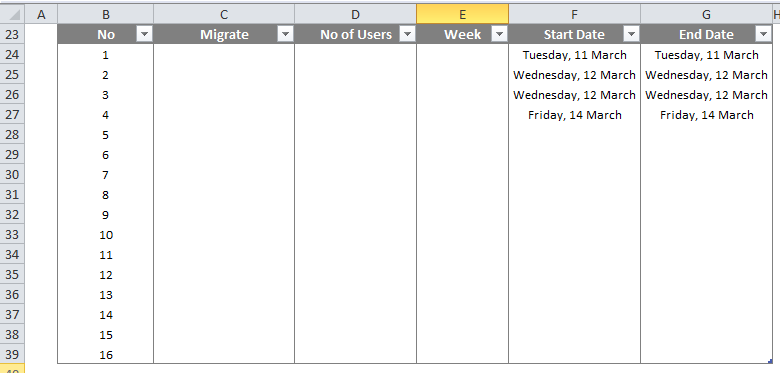
enter image description here

Note that more than one row can be lit up at once.

Why community consensus is tight on this one

Across 303 Excel VBA entries in the archive, the accepted answer here holds strong answer (top 25 %%) status — meaning voters are unusually aligned on the right fix.


The Verified Solution — strong answer (top 25 %%) (+16)

Advisory answer — community consensus with reference links

Note: the verified answer below is a reference / advisory response rather than a copy-ready snippet.

STEP 1:

Select your table without headers (B24:G31 in image below).

With selected table go to HOME->CONDITIONAL FORMATTING->New Rule...
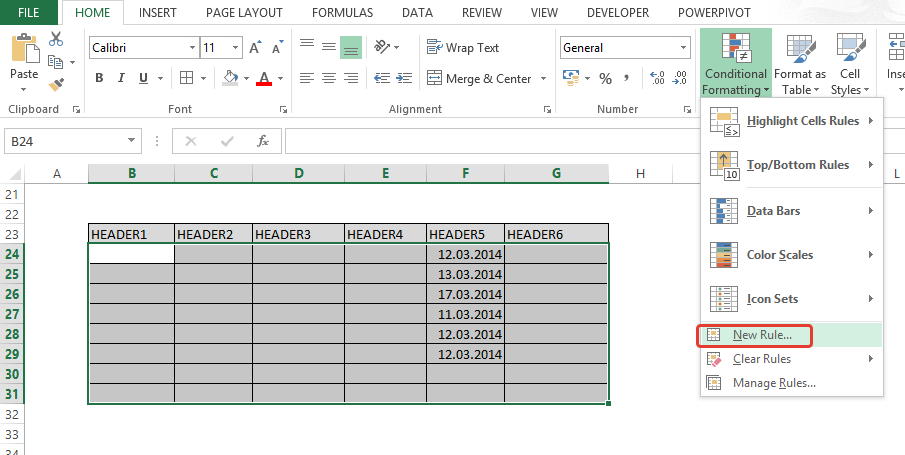
enter image description here

STEP 2:

Select Use formula to determine which cells to format, enter formula: =$F24=TODAY(), choose desired formatting and press OK.

enter image description here

RESULT:

enter image description here


When to Use It — classic (2013–2016)

Ranked #60th in its category — specialized fit

This pattern sits in the 95% tail relative to the top answer. Reach for it when your scenario closely matches the question title; otherwise browse the Excel VBA archive for a higher-consensus alternative.

What changed between 2014 and 2026

The answer is 12 years old. The Excel VBA object model has been stable across Office 2013, 2016, 2019, 2021, 365, and 2024/2026 LTSC, so the pattern still compiles. Changes that might affect you: 64-bit API declarations (use PtrSafe), blocked macros in downloaded files (Mark-of-the-Web), and the shift toward Office Scripts for web-first workflows.

help
Frequently Asked Questions

Why does this sit in the top quartile of Excel VBA answers?
expand_more

Answer score +16 vs the Excel VBA archive median ~5; this entry is strong. The score plus 11 supporting upvotes on the question itself (+11) means the asker and 15 subsequent voters all validated the approach.

This answer links out — what are the reference links worth following?
expand_more

Read the first external link for the canonical reference, then search this archive for a top-10 entry in the same category — advisory answers are best paired with a ranked code snippet to close the loop.

Published around 2014 — what’s changed since?
expand_more

Published 2014, which is 12 year(s) before today’s Office 2026 build. The Excel VBA object model has had no breaking changes in that window. Three things to re-test: (1) blocked macros on downloaded files (Mark-of-the-Web), (2) 64-bit API declarations (PtrSafe, LongPtr), (3) any shift toward Office Scripts for web scenarios.

Which Excel VBA pattern ranks just above this one at #59?
expand_more

The pattern one rank above is “How to get images to appear in Excel given image url”. If your use case overlaps, compare both before committing.

Data source: Community-verified Q&A snapshot. Q-score 11, Answer-score 16, original post 2014, ranked #60th of 303 in the Excel VBA archive. Last regenerated April 14, 2026.