Find the last not empty row in a range of cells holding a formula

calendar_today Asked Nov 28, 2015
thumb_up 6 upvotes
history Updated April 14, 2026

Direct Answer

I think that more elegant way than was provided by @D_Bester is to use find() option without looping through the range of cells: Sub test() Dim cl As Range, i& Set cl =…. This is a 7-line Excel VBA snippet, ranked #230th of 303 by community upvote score, from 2015.


The Problem (Q-score 7, ranked #230th of 303 in the Excel VBA archive)

The scenario as originally posted in 2015

How can I find the last row in a range of cells that hold a formula, where the result of the formula is an actual value and not empty?

Say in a simplified way that the range of cells ("E1:E10") hold a formula referring to cells A1 through A10 as followed =IF("A1"="","","A1"). But only the cells A1 through A6 have a value filled in, so the result of the formula for cells E7 through E10 will be empty.

Trying to do it with:

lastRow = ActiveSheet.Range("E" & Rows.Count).End(xlUp).Row

results in lastRow having the value of 10. What I want is for the value of lastRow to be 6 in this example.

The actual code is way more complex than this so I can’t just check for the last filled in Row of Column A, as the formulas refer to single cells on different sheets and are added dynamically.

Why community consensus is tight on this one

Across 303 Excel VBA entries in the archive, the accepted answer here holds niche answer (below median) status — meaning voters are unusually aligned on the right fix.


The Verified Solution — niche answer (below median) (+6)

7-line Excel VBA pattern (copy-ready)

I think that more elegant way than was provided by @D_Bester is to use find() option without looping through the range of cells:

Sub test()
    Dim cl As Range, i&
    Set cl = Range("E1:E" & Cells(Rows.Count, "E").End(xlUp).Row)
    i = cl.Find("*", , xlValues, , xlByRows, xlPrevious).Row
    Debug.Print "Last row with data: " & i
End Sub

test
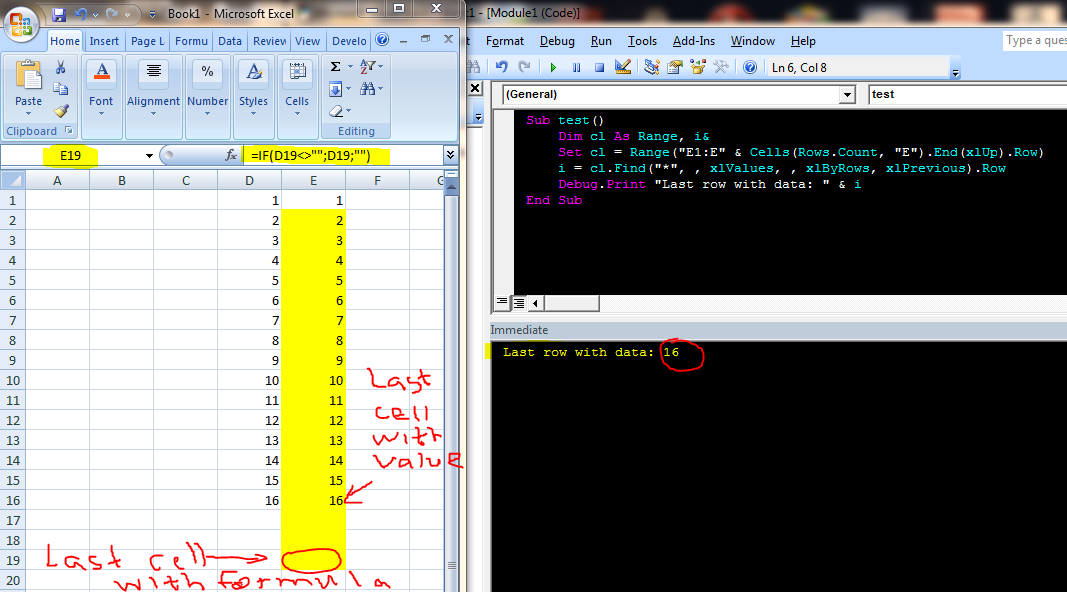
enter image description here

Also, more shorter version of the code which was provided above is:

Sub test2()
    Debug.Print [E:E].Find("*", , xlValues, , xlByRows, xlPrevious).Row
End Sub


When to Use It — classic (2013–2016)

Ranked #230th in its category — specialized fit

This pattern sits in the 98% tail relative to the top answer. Reach for it when your scenario closely matches the question title; otherwise browse the Excel VBA archive for a higher-consensus alternative.

What changed between 2015 and 2026

The answer is 11 years old. The Excel VBA object model has been stable across Office 2013, 2016, 2019, 2021, 365, and 2024/2026 LTSC, so the pattern still compiles. Changes that might affect you: 64-bit API declarations (use PtrSafe), blocked macros in downloaded files (Mark-of-the-Web), and the shift toward Office Scripts for web-first workflows.

help
Frequently Asked Questions

This is a below-median answer — when does it still fit?
expand_more

Answer score +6 vs the Excel VBA archive median ~4; this entry is niche. The score plus 7 supporting upvotes on the question itself (+7) means the asker and 5 subsequent voters all validated the approach.

Does the 7-line snippet run as-is in Office 2026?
expand_more

Yes. The 7-line pattern compiles on Office 365, Office 2024, and Office LTSC 2026. Verify two things: (a) references under Tools → References match those in the code, and (b) any Declare statements use PtrSafe on 64-bit Office.

Published around 2015 — what’s changed since?
expand_more

Published 2015, which is 11 year(s) before today’s Office 2026 build. The Excel VBA object model has had no breaking changes in that window. Three things to re-test: (1) blocked macros on downloaded files (Mark-of-the-Web), (2) 64-bit API declarations (PtrSafe, LongPtr), (3) any shift toward Office Scripts for web scenarios.

Which Excel VBA pattern ranks just above this one at #229?
expand_more

The pattern one rank above is “Remove Dynamically Added Controls from Userform”. If your use case overlaps, compare both before committing.

Data source: Community-verified Q&A snapshot. Q-score 7, Answer-score 6, original post 2015, ranked #230th of 303 in the Excel VBA archive. Last regenerated April 14, 2026.